Ils en parlent en anglais sur cette page. La seule qui est encore active sur le site apparement.
''Boulengerichromis microlepis grows to about 70cm and the yet to be described Altolamprologus sp. "Micro", endemic to Cape Mpimbwe, does not grow larger than 20mm.''
gwea a écrit :Ils en parlent en anglais sur cette page. La seule qui est encore active sur le site apparement.
''Boulengerichromis microlepis grows to about 70cm and the yet to be described Altolamprologus sp. "Micro", endemic to Cape Mpimbwe, does not grow larger than 20mm.''
Here it is in English - now Estelle can translate it into French :P2
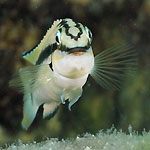
Altolamprologus sp. "calvus Micro", by Ingemar Bengtsson. First published in Ciklidbladet (Journal of the Scandinavian Cichlid Association) vol. 04/1993.
The existence of this undescribed Altolamprologus came to my knowledge when I visited Åleds Aquarium in autumn 1991. A shipment of wildcaught Tanganyika cichlids contained 5 A. sp. ?Calvus Micro?. These 5 fishes as well as 2 more from an additional shipment were bought, and placed in 60 l. aquarium, decorated with some small rocks and some shells.
A. sp. "Calvus Micro"
A sp. "Calvus Micro" is as the name indicates a small fish, and at the time they were obtained the smallest measured 25 mm and the biggest 40 mm, which is the maximum size found in the Lake according to the exporter. A. sp. ?Calvus Micro? is a miniature of the common A. calvus and is not a very colourful fish, as it is coloured in greyish tones depending on mood and the colour of the substrate. Differences between the sexes are not observable, but males are generally larger than females.
A shell-dweller
The exact place of collection is a well kept secret, but after an inquiry of Magnus from the Swedish export station, it is clear that the collection place is near Cape Mpimbwe, Tanzania. Depth of collection is 25 to 30 meters with a sandy bottom containing scattered shells, in which A sp. ?Calvus Micro? are caught when they seek shelter for the divers. A. sp. ?Calvus Micro? is apparently a rare species, as the 7 specimens I obtained are the only ones collected.
That A. sp. ?Calvus Micro? is a shell-dweller is evident on its behaviour in the aquarium, as the females each occupy a shell. Half a year went by without observing any spawning behaviour, even if I tried all kinds of tricks.
Incidentally I came up with a solution to the problem, when I installed a 130 l. aquarium, to which the fishes were moved. Any light for the aquarium was not ready, and it was not lit for a couple of weeks. In this dim light (daylight and light from other aquariums) a higher level activity was observed from the A. sp. ?Calvus Micro?, and already after one week it was evident that one of the females was ready to spawn
The spawning.
The spawning of A. sp. ?Calvus Micro? takes place like this: a female occupy a shell, and make a territory around it. In the aquarium the territory is a couple of dm2, but it is likely to encompass several m2 in the Lake. When the female is ready to spawn, she allows a male to enter the territory and the shell to spawn. The female stay in the shell guarding the eggs, while the male defends the territory. When the eggs are hatched and the fry become free-swimming, the female chases the male, who would otherwise eat the fry, out of the territory. The fry grow slowly. There can be up to 50 fry in one clutch, which is a lot for such a small cichlid.
Hulk a écrit :Thanks a lot, Thomas. Could you also translate the photos from Swedish to English? I'll then translate them to french. :DD
:lol:
Apparantly this little cichlid from Cape Mpimbwe seems to be lost for the hobby, as many of the other species/variants discovered by African Diving - quite a shame. Take good care of yours, Benoit!
UNe petite question me vient, ce "calvus nain" capturé à Mpimbwe (défini par qui, et sur quels critères comme "calvus?), est hors répartition de calvus, que peut-on en déduire ?
UBUNTU « Je suis ce que je suis grâce à ce que nous sommes tous »
Justement, j'aimerais bien voir s'il s'agit réellement d'un calvus. C'est pour ça que j'espérais que Thomas pourrait nous montrer les photos qui illustrent l'article. :wink:
Le tien de Munene est vraisemblablement un compressiceps nain. Et très vraisemblablement, il n'est pas directement apparentés aux "nains" de Zambie. Le nanisme a dû apparaître indépendamment en plusieurs endroits, à la base, il s'agit d'écotypes, certainement.
This dwarf from Mpimbwe is actually mentioned in Konings 1998 book (Tanganyika Cichlids in their natural habitat) p. 91 (the English edition), and the assignement to "calvus" are likely to be an error:
A smaller shell-brooding A. compressiceps has apparently been found near Cape Mpimbwe as well. The local variant of A. compressiceps is black and resembles A. calvus, and this may have confused the discoverers of the shell-brooding miniature form because it is known in the hobby as "Shell Calvus" (Max Bjørneskov, pers.comm.)
Oui, en effet, il y a peu de chances que ce soit un calvus nain, puisque toutes les formes naines ont la silhouette d'A. compressiceps. Pour s'en assurer, le mieux serait de voir si les écailles de l'arrière de la tête sont absentes (calvus = chauve [bald]).
Mais si je comprends bien, cette forme serait encore plus petite que celle de Sumbu? et par la même occasion l'un des plus petits cichlidés du monde?
[Thomas, I hope you understand me, otherwise, let me know.]
Créer un compte ou se connecter pour rejoindre la discussion
Vous devez être membre pour pouvoir répondre
Créer un compte
Vous n‘êtes pas membre ? Inscrivez-vous pour rejoindre notre communauté
Les membres peuvent créer leurs propres sujets et s‘abonner à des sujets
C‘est gratuit et cela ne prend qu‘une minute
C'est le moment de reprendre ou prendre son adhésion pour avoir les revues de l'année en cours et de ne pas manquer le reste de l'actualité de l'AFC et de ce qu'il se passe en région.
Mais aussi et surtout, soutenir VOTRE association.