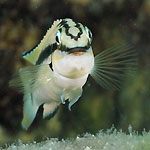
Sparks, J. (2008) : Phzlogeny of the cichlid subfamily Etroplinae and taxonomic revision of the malagasy cichlid genus Paretroplus (Teleostei: Cichlidae). Bulletin of the American museum of Natural history 314: 151 pp.
Abstract:
A species-level phylogeny for Etroplinae is presented, based on the simultaneous analysis of morphological and nucleotide characters, and species of the endemic Malagasy genus Paretroplus are taxonomically revised, including the description of two new species. Relative to most other cichlid genera, Paretroplus is diagnosed by numerous anatomical features, including morphology of the gas bladder, neurocranium, oral jaws and dentition, and suspensorium. Keys to the genera of Malagasy?South Asian cichlids and to the species of Paretroplus are provided. Paretroplus is endemic to Madagascar and is the sister genus to Etroplus, endemic to southern India and Sri Lanka. Together these two genera comprise the subfamily Etroplinae. Paretroplus comprises 12 species, two of which are described herein as new. Three morphologically distinct clades are recovered within Paretroplus, one comprising the comparatively elongate, primarily riverine and rheophilic species P. damii, P. nourissati, P. tsimoly, and P. lamenabe, new species, the second comprising the deep-bodied, primarily lacustrine species P. polyactis, P. petiti, P. kieneri, P. maculatus, P. menarambo, P. maromandia, and P. dambabe, and the third comprising the shallow-bodied and highly mottled species P. kieneri and P. gymnopreopercularis, new species, which occur in both lentic and lotic habitats. Monophyly of Etroplinae and Etroplus are also discussed and diagnostic anatomical features are presented for both clades. The sister-group relationship between Etroplus and Paretroplus represents a well-corroborated transoceanic link within Cichlidae, a pattern congruent with the Mesozoic fragmentation of Gondwana. The anterior of the gas bladder is highly modified in Etroplinae, reaching its most derived configuration in Paretroplus, in which multiple, structurally complex and rigid anterior bullae expand into large exoccipital recesses, forming a mechanical (5 otophysic) connection between the gas bladder and inner ear. Evolution of the gas bladder, and its function in conferring increased hearing ability, is discussed in terms of the phylogenetic information this structure provides for reconstructing hypotheses of relationships within Cichlidae.
Pas encore le PDF...si qlq un a deja je suis preneur!!
A++
Yann
"Don't surrender without fighting"
"Don't give up! Don't ever give up!!!"
J'avais choppé le lien mais pas eu la clairvoyance matinale de patienter 22 heures que le pdf charge mais ce matin ça a marché nikel (en moins d'une journée de boulot de 8 heures quoi !)...
Il n'y a plus qu'à lire ces 150 pages...
Créer un compte ou se connecter pour rejoindre la discussion
Vous devez être membre pour pouvoir répondre
Créer un compte
Vous n‘êtes pas membre ? Inscrivez-vous pour rejoindre notre communauté
Les membres peuvent créer leurs propres sujets et s‘abonner à des sujets
C‘est gratuit et cela ne prend qu‘une minute
C'est le moment de reprendre ou prendre son adhésion pour avoir les revues de l'année en cours et de ne pas manquer le reste de l'actualité de l'AFC et de ce qu'il se passe en région.
Mais aussi et surtout, soutenir VOTRE association.